
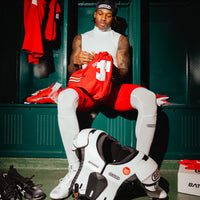











Walk into any football locker room, from pee-wee to the NFL, and you’ll see the same thing: every player pulling on a compression shirt before the pads go on.
That’s not tradition. That’s an edge. Compression shirts deliver real, measurable benefits that impact how you perform, recover, and feel on the field.
This guide breaks down exactly why football players wear compression shirts, covering everything from muscle support and blood flow to protection under pads and mental confidence. Whether you're gearing up for your first season or looking to upgrade your base layer game, you'll learn what makes compression shirts essential football gear and how to choose the right one for your position and playing style.

1. Muscle Support and Reduced Fatigue
Football players wear football compression shirts primarily because the tight-fitting fabric holds muscles firmly in place during explosive movements. Sprint, cut, collide, your muscles naturally vibrate. That costs energy.
Compression gear helps reduce muscle vibration1, which means your body expends less energy stabilizing itself throughout every play.
They also improve proprioception, or your body’s ability to know where it is without looking. When the play breaks down and everything speeds up, that awareness matters.
Different positions benefit in unique ways from this support:
- Offensive and defensive linemen gain core stability during blocking and pass rushing
- Receivers and defensive backs experience improved upper-body control when running routes and making catches
2. Improved Blood Circulation and Recovery
Compression doesn’t stop working after the play.
Sports science research supports wearing compression garments to help athletes recover strength, power, and endurance more quickly2 after intense physical activity. Here’s what that looks like in action:
- Improved blood flow helps muscles stay energized during play
- Faster removal of lactic acid reduces delayed onset muscle soreness (DOMS) after games
- Better recovery means you’re ready for the next practice, not dragging through it
Smart players take advantage of this by leaving their compression shirt on during and after practice. This simple habit helps muscles recover faster and can make a real difference when you prepare for summer football camp, grind through two-a-days, or push deep into playoff runs when recovery time is limited.

3. Protection Under Pads
Beyond performance benefits, compression shirts serve as a crucial barrier between your skin and your equipment. Without that layer, pads rub. Friction builds. Skin breaks down. That’s where problems start.
Here’s what compression helps prevent:
- Chafing from shoulder pads during repeated contact
- Irritation and raw spots that build up over the season
- Turf burns when you hit the ground on artificial surfaces
A compression layer eliminates this friction and is a key part of what to wear under football pads. Meanwhile, some compression shirts come with foam padding built into high-impact zones around the ribs and shoulders. These designs add an extra layer of cushioning without the bulk of separate types of football pads.
For younger athletes, this is even more important as part of their youth football equipment. Pads don’t always fit perfectly, and that extra layer helps everything stay in place. More protection. Less distraction.
Artificial turf surfaces present another hazard that compression gear helps address. Turf burns from sliding across synthetic fields can sideline players and create infection risks. Pairing your compression shirt with football turf tape on exposed areas gives you comprehensive protection from these painful abrasions.
4. Moisture Management and Comfort
Cotton undershirts soak up sweat and become heavy, soggy distractions that weigh you down as the game goes on. Moisture-wicking clothing like most compression fabrics pull perspiration away from your skin and spread it across the material's surface where it evaporates quickly.
Here’s why it matters:
- Moisture-wicking fabric keeps sweat from soaking into your gear
- A tight fit prevents bunching under pads
- Ventilation panels help regulate temperature during high-intensity play
5. Psychological Benefits
The mental side of the game matters just as much as the physical, and compression shirts contribute here too. Many players consistently report feeling more stable, supported, and locked in when wearing compression gear. This sensation comes from the constant proprioceptive feedback the fabric provides.
When your drip feels right, your mind stays on the game instead of wandering to distractions. You stop worrying about adjusting a loose undershirt or dealing with discomfort and start focusing entirely on your assignment. When you feel supported, you perform better under pressure.
Integrated vs. Non-Integrated Compression Shirts
Compression shirts fall into two main categories. Your choice depends on how much contact you typically absorb and whether mobility or protection ranks higher on your priority list.
Integrated (Padded) Compression Shirts
These shirts feature protective foam sewn directly into areas that take the most punishment during games. Padding typically covers the ribs, shoulders, and sternum to absorb impact from collisions.
A padded football compression shirt works best for linemen, linebackers, and any player who spends practices and games in constant physical contact. The built-in protection eliminates the need for separate padding pieces while keeping everything streamlined under your shoulder pads.
Non-Integrated (Standard) Compression Shirts
Standard compression shirts skip the padding entirely and focus on delivering muscle support, moisture management, and comfort in a lightweight package. Nothing gets between you and maximum range of motion.
Skill position players like receivers, defensive backs, and running backs often prefer this style because speed and agility matter more than extra cushioning. These lightweight options also work well for low-contact practice sessions and offseason conditioning.

When Should You Wear a Compression Shirt?
Compression shirts prove useful far beyond just game days. Consider wearing yours in these situations:
- Game day - Layer it under your shoulder pads for the full combination of protection, comfort, and performance support
- Practice - Especially valuable during strenuous full-contact sessions and exhausting two-a-days
- Post-activity - Keep it on after games or practice to support faster recovery and minimize next-day soreness
- Cold weather - Use it as a thermal base layer to retain body heat during late-season competition; add compression tights and football sleeves for full-body warmth
- Offseason training - Wear compression during offseason football workouts, weight room sessions, and conditioning to maintain muscle support
Are Compression Shirts Required in Football?
No major football organization, including the NFL, NCAA, or NFHS, mandates compression shirts as part of the required uniform. However, the overwhelming majority of football players choose to wear them because the benefits of compression apparel are simply too significant to ignore.
Keep in mind that leagues often have rules about base layer colors and visible apparel styles. Always check with your coach or review your league's guidelines before game day to make sure your compression wear meets the dress code.
How to Choose the Right Football Compression Shirt
When you choose compression gear for football, finding the perfect compression shirt comes down to evaluating a few key factors:
- Fit - Look for snug but not restrictive. The shirt should feel like a second skin without limiting your breathing or digging into your shoulders
- Material - Prioritize moisture-wicking, breathable fabrics like polyester-spandex blends. Stay away from cotton, which holds sweat and loses its shape
- Padding - Choose integrated padding for high-contact positions or go with non-integrated options if speed and mobility come first
- Durability - High-quality compression gear should maintain its elasticity through multiple seasons
- Style - Pick from short sleeve, sleeveless, mock neck, or turtleneck based on weather conditions and personal preference
FAQs About Football Compression Shirts
Do compression shirts actually improve performance?
Yes. The muscle support, reduced fatigue, and enhanced proprioception they provide all contribute to better play on the field, and sports science research backs these benefits.
Can youth football players wear compression shirts?
Absolutely. Athletes at every age and skill level benefit from compression gear, though finding the correct size for a proper fit is essential for younger players.
How tight should a football compression shirt be?
It should feel snug and secure like a second skin, but never so tight that it restricts your breathing or leaves deep marks on your skin after removal.
Do compression shirts help in cold weather?
Yes, compression shirts can help in cold weather, but mainly when they’re designed as thermal/“cold‑gear” base layers and used under other clothing.
Gear Up with Battle Sports
Compression shirts have earned their place as essential equipment for football players who want every possible advantage. From keeping muscles fresh and speeding recovery to protecting your skin and sharpening your mental focus, these base layers deliver benefits that impact every aspect of your game.
Battle Sports is a leading provider of football gear, accessories, equipment, and athletic apparel designed for athletes at all levels. With a focus on innovation, protection, and style, Battle Sports equips players with everything needed to perform at their best while expressing their unique identity on the field. Level up your entire football drip with gear that matches your competitive drive and get game-ready from the inside out.
Sources:
- MDPI. (2026). From Material to Manufacture: A State-of-the-Art Review of Compression Garment Technologies for Medical and Sports Use. https://www.mdpi.com/2673-7248/6/1/7
- National Center for Biotechnology Information. (2025). Effects of Compression Garments on Muscle Strength and Power Recovery Post-Exercise: A Systematic Review and Meta-Analysis. https://pmc.ncbi.nlm.nih.gov/articles/PMC11944185/