










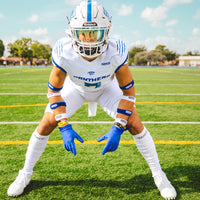



If you want to play football at a high level, you don't stop at hoping you’ll improve. You start training like someone who refuses to stay average.
There are plenty of ways to become better. Watching YouTube tutorials. Copying drills you see online. Running random workouts in the off-season. But improvement doesn’t happen by accident. It happens when your physical and mental preparation match the game's intensity. Football rewards edge. It rewards preparation.
Getting better is about the full package: skills, mindset, and showing up with the right football drip to match your work ethic.
If you’re serious about unlocking your full potential, these 10 strategies will help you develop speed, strength, awareness, and confidence, and deliver the results you want.
Let’s get to work.

1. Master Position-Specific Footwork
Every explosive play starts from the ground up.
If your feet are slow, everything else is slow. Great football players build from quick feet, balance, and controlled violence in every cut.
That means training must be football-specific, not random cardio.
Skill Positions (WR, RB, DB)
Wide receivers, running backs, and defensive players need lightning-quick feet that can change direction instantly. Key drills for skill positions include:
- Ladder drills - Build the rapid foot speed required to make sharp cuts and leave defenders behind
- Cone drills - Develop hip fluidity, allowing you to sink your hips and explode out of breaks without losing momentum
- Backpedaling-to-sprint transitions - Essential for defensive backs who must read the quarterback while moving backward
- Mirror drills - Going against a live opponent instead of a stationary dummy
Elite movement shows up at game speed, not half speed.
Linemen (OL, DL)
Offensive and defensive linemen win battles through controlled, powerful footwork rather than pure speed. Research shows that 79 percent of the distance covered is low intensity for offensive linemen during games, which is why proper technique matters so much.
Essential footwork drills for linemen:
- Kick slides - Help offensive linemen mirror pass rushers effectively
- Punch-and-redirect steps - Allow defenders to shed blocks with power
- Short, choppy lateral shuffles - Keep you balanced and ready to engage
Building explosive lower-half drive increases strength and mass while keeping you mobile. Every rep is a full body engagement, not just legs, not just arms.
Quarterbacks
Clean mechanics create confidence.
Three-step, five-step, and seven-step drops each serve different route concepts, and sloppy footwork throws off timing with receivers.
Quarterbacks can work on pocket movement drills, reset mechanics, and off-platform throws to simulate pressure instead of throwing routes on air like it’s warmups. In this case, wearing quality football cleats supports the precise planting and pivoting that every position demands.

2. Put In Extra Work Outside Of Team Practice
Team practice teaches schemes and playbook execution, but individual improvement happens in the extra minutes you invest outside scheduled practice. Arrive early to team activities. Stay late. Put in work outside of scheduled practice.
Position-specific extra work that makes a difference:
- Wide receivers - Catch fifty additional balls using a teammate or wall drills
- Defensive backs - Extra backpedal-and-break reps to sharpen reaction time
- Linemen - Practice tackling form on a pad or controlled dummy.
Consistency compounds over time, and coaches notice players who put in work when no one else does. Quality football gloves maintain their grip through hundreds of extra catches, supporting the volume that separates starters from backups.
3. Build Explosive Power With Plyometrics
Lifting heavy doesn’t automatically translate to performance.
Football demands force applied as quickly as possible. Plyometrics, Olympic lifts, and resisted sprints are elite training methods that enhance the elasticity of muscles and tendons and improve neuromuscular efficiency through the stretch-shortening cycle.
Plyometric Drills For Football
Essential plyometric exercises for football power:
- Box jumps - Train your legs to generate maximum force in minimal time
- Lateral bounds - Develop hip power for side-to-side movement
- Broad jumps - Build horizontal explosion for driving through tackles
- Jump squats and depth jumps - Challenge your nervous system to recruit muscle groups faster
These movements build full body coordination and power transfer. They improve acceleration, jump-ball timing, and first-step dominance.
This is how you train for real collision speed, not Instagram highlights.
Strength Training Essentials
Compound movements like squats, deadlifts, and power cleans build the full-body strength football demands. Bench press and overhead press develop upper-body power for blocking and shedding.
Training two to four days weekly keeps you progressing without overtraining, and tracking your numbers reveals whether your program works. Younger athletes should prioritize bodyweight movements and proper form before adding heavy loads.
4. Develop Conditioning With Sprint Ladder Workouts
Anyone can run hard in the first quarter. The difference shows at the end of the game. Because in crunch time, when everyone else is exhausted, you should still be explosive.
Football conditioning differs from distance running because games consist of repeated short bursts with brief rest periods. Sprint ladder workouts mimic this pattern by increasing distances with controlled recovery.
Try sprinting ten yards, resting twenty seconds, then twenty yards with thirty seconds rest, followed by forty yards with forty-five seconds rest. Repeat this sequence three to five times for sessions that build endurance for fourth-quarter intensity.
Football players who maintain full speed at game's end gain a massive advantage over fatigued opponents. Pushing through discomfort during conditioning builds the mental stamina that separates winners from everyone else.

5. Master Agility And Change-Of-Direction Drills
Football happens in angles, cuts, and sudden direction changes rather than straight lines. Essential agility drills you can practice include:
- Five-ten-five shuttle - Develops explosive lateral movement and direction changes
- Three-cone L-drill - Builds sharp cutting ability and body control
- T-drill: Enhances multi-directional speed and agility
- Reactive cone drills - Train your body to respond without thinking when a teammate calls directions
Agility improves through repetition, and these movement patterns reinforce the footwork fundamentals that make athletes dangerous in space.
6. Study Film To Prepare Mentally
Talent reacts. Smart players anticipate.
Knowing the rules of the game is step one. Understanding how to bend those rules better than your opponent is step two.
How To Study Opponent Film
Watch for formation tendencies and alignment cues that reveal play calls before the snap. Identify what opponents do in specific down-and-distance situations, then write those patterns down so you remember them on game day.
Study opponent tendencies like:
- Down-and-distance calls
- Blitz indicators
- Safety rotation
- Formation tells
Knowing the other team's tendencies eliminates guesswork and lets you attack with confidence. Even a few hours of focused study gives you information most of your opponents never bother to gather.
How To Study Your Own Game Film
Watching yourself reveals the gap between what you think happened and what actually occurred. Focus on technique breakdowns, including:
- Pad level
- Hand placement
- Effort
- Missed assignments
Ask your coach to watch alongside you and provide specific feedback. This habit demonstrates commitment and accelerates your development faster than solo study.
7. Train With Better Competition
Comfort prevents growth because dominating every practice means nobody challenges you. If your current skill level isn’t being challenged, you’re not improving. Seek environments where better players expose your weaknesses and force you to adapt.
Play up. Compete in regional or summer football camps. Enter 7-on-7 tournaments. Line up across from athletes better than you.
Playing against older, more experienced athletes teaches lessons that comfortable practices never will. Growth happens when you’re uncomfortable.
8. Develop Field Awareness And Anticipation
Great players process information before plays develop rather than reacting after contact begins. Reading pre-snap keys creates the advantage of knowing what's coming while opponents still guess.
Pre-Snap Reads By Position
Generic workouts create generic results. Invest in specific training tailored to your role.
Every position has specific pre-snap keys to master:
- Quarterbacks - Identify safety rotation and coverage shells before the snap
- Receivers - Recognize press versus off coverage to adjust their release and route running
- Defensive player - Read formations to anticipate route concepts
- Linemen and linebackers - Look for blitz indicators and stunt patterns that reveal where pressure originates
Training must mirror actually playing your sport, not just sweating for an hour.
Scanning And Processing Speed
Train your eyes to survey the field quickly rather than locking onto single players. Practice pre-snap routines until they become automatic, freeing your mind to process information faster during live action.

9. Maintain Proper Nutrition And Recovery
Training breaks your body down, and what you do between sessions determines whether you rebuild stronger. Neglecting nutrition and sleep sabotages even the most dedicated practice habits.
If you’re serious about the next level, you must build power intelligently.
That means:
- Progressive overload
- Prioritizing compound lifts
- Smart training sessions
- Tracking numbers
Football Nutrition Basics
Building muscle isn’t just about size. It’s about building lean, durable strength.
To increase size, you may need a slightly higher calorie intake. For linemen, that might include beef and pork alongside cleaner options. For skill players focused on speed, emphasize lean meats and quality carbs.
Essential nutrition for football performance include:
- Lean proteins - Chicken, fish, lean red meat, and eggs repair muscle tissue damaged during training. Getting enough protein supports recovery, muscle repair, and building muscle without unnecessary bulk.
- Complex carbohydrates - Rice, oats, and sweet potatoes provide sustained energy without sugar crashes
- Consistent hydration - Drink water throughout the day, as performance suffers before thirst registers. Research shows that collegiate American football linemen can lose 4–6 kg of body water during a single summer practice session, making rehydration essential for recovery.
Also, avoid processed foods and excess sugar, which undermine your physical investment.
Recovery That Keeps You Consistent
Key recovery practices for consistent performance:
- Sleep: Eight to nine hours allows your body to complete its healing processes
- Stretching and foam rolling: Maintains mobility and reduces injury risk after training
- Light movement on rest days: Promotes blood flow without adding stress
Consistent recovery ensures you can train at full intensity and continue making progress.
10. Train With Purpose And Intent
Every rep has a purpose. If you want to achieve your goals, whether that’s taking more snaps, earning varsity, or reaching the next level, you must train with urgency.
Seek coaching feedback actively rather than waiting for instruction. Track your lifts, film your reps, and time your sprints because measuring progress reveals what works. NFL players never stop refining fundamentals. Unlock your full potential by attacking every rep like it matters.
Showing up with the right mindset and fresh football drip sets the tone for productive sessions. Intentional practice transforms potential into peak performance.
Common Mistakes That Slow Improvement
Avoid these common training traps:
- Random workouts without position-specific training - Waste time that could build relevant skills
- Running miles when shuttles matter more - Misallocates your energy toward the wrong conditioning
- Ignoring recovery - Undermines your physical investment and leads to diminishing returns
- Skipping film study - Means repeating mistakes you could easily correct
- Treating practice reps casually - Trains your body to perform casually when games matter
Elevating Your Game With Battle Sports Football Gear
Preparation isn’t complete without gear built for collision.
At Battle Sports, every product is designed and tested in Battle Labs under real football conditions. Gloves engineered for grip at the legal stick limit. Mouthguards built for protection without bulk. Cleats made for violent cuts at game speed. Because confidence shows up when equipment performs.
When you step onto the football field, your preparation should match your ambition. Battle Sports' football gear supports athletes who refuse to stay average — from youth players learning to play football the right way to competitors pushing toward their full potential.
Train harder. Train smarter. Show up ready.
And when it’s time to compete, make sure to explore football gear that hits as hard as you do.
Sources:
- National Federation of State High School Associations (NFHS). (n.d.). Heat Acclimatization for Linemen in High School Football. https://www.nfhs.org/stories/heat-acclimatization-for-linemen-in-high-school-football
- Nature (Scientific Reports). (n.d.). Effects of plyometrics training on lower limb strength, power, agility, and body composition in athletically trained adults: systematic review and meta-analysis. https://www.nature.com/articles/s41598-025-10652-4
- PubMed Central (National Center for Biotechnology Information, NIH). (n.d.). Reference Values for Hydration Biomarkers: Optimizing Athletic Performance and Recovery. https://pmc.ncbi.nlm.nih.gov/articles/PMC11989602/
- American Dental Association (ADA). (n.d.). Athletic mouth protectors (mouthguards). https://www.ada.org/resources/ada-library/oral-health-topics/athletic-mouth-protectors-mouthguards